
Old-Fashioned Filled Raisin Cookies
Some recipes are more than instructions written on paper. They are memories, traditions, and quiet expressions of love passed down through generations. Old-Fashioned Filled Raisin Cookies belong firmly in that category. These cookies are not quick, trendy, or decorative. They are practical, hearty, and deeply comforting, made with patience and intention. For many families, they appear once a year, carefully prepared and stored away, meant to last and to be savored slowly.
This recipe represents an era when baking was guided by instinct rather than precision. Phrases like “enough flour to roll” or “a heaping teaspoon” tell the story of experienced hands that knew dough by feel and filling by smell. These cookies are small hand pies, sealed with care, each one holding a sweet raisin filling brightened with orange zest and enriched with pecans. They are humble, yet deeply satisfying.
The History Behind Filled Raisin Cookies
Filled raisin cookies have roots in early American and European baking traditions. Raisins were a common sweetener before refined sugar became widely available, and dried fruit was valued for its long shelf life. In colder months, families relied on preserved ingredients such as raisins, nuts, and citrus peel to bring flavor to their baking. These cookies were practical, nourishing, and filling, making them ideal for large families and long winters.
Unlike modern cookies that are often soft or chewy, these cookies lean closer to pastry. The dough is rolled out, filled, sealed, and baked much like a pie. This method allowed bakers to stretch ingredients while still creating something special. Each cookie was substantial enough to be satisfying on its own, which made them perfect for storage and sharing.
Why These Cookies Are Special
What sets Old-Fashioned Filled Raisin Cookies apart is the balance between simplicity and effort. The ingredients themselves are straightforward: flour, sugar, shortening, eggs, raisins, nuts, and citrus. However, the process takes time. The filling must be cooked and cooled. The dough must be rolled and cut. Each cookie is assembled by hand, sealed carefully to protect the filling inside.
This is not a recipe designed for speed. It is designed for care. The repetitive motions of rolling, filling, and sealing create a rhythm that many bakers find calming. It is the kind of baking that invites conversation, memory, and reflection, especially when made during the holidays.
Ingredients That Stand the Test of Time
The dough for these cookies is rich and sturdy, made with shortening rather than butter. This choice gives the cookies structure and helps them hold their shape during baking and freezing. The sugar adds sweetness, while eggs provide richness and binding. Milk softens the dough, making it easier to roll thin without tearing.
The filling is the heart of the cookie. Raisins are simmered with sugar and water until soft and plump, then thickened with cornstarch. Orange zest adds brightness and depth, cutting through the sweetness of the raisins. Chopped pecans provide texture and a subtle nuttiness that complements the fruit. Together, these ingredients create a filling that is rich without being heavy.
Making the Filling
The filling should always be prepared first. This allows it to cool completely before being placed onto the dough. Hot filling can melt the dough and make sealing difficult. Cooking the raisins slowly ensures they soften evenly and release their natural sweetness into the mixture.
Once the raisins are simmered, the cornstarch slurry is added gradually. This step requires attention, as the mixture thickens quickly. Stirring constantly prevents lumps and ensures a smooth, spreadable consistency. After thickening, the pecans are stirred in, and the filling is set aside to cool.
Preparing the Dough
The dough is mixed by creaming the sugar and shortening, then adding eggs, salt, vanilla, and milk. The flour and baking powder are incorporated gradually, allowing the baker to judge the texture. The goal is a dough that is soft but not sticky, firm enough to roll out thin without cracking.
This kind of dough improves with rest. Allowing it to sit for a short time makes it easier to handle and roll evenly. Generous flour on the work surface prevents sticking and tearing, which is especially important when rolling to a thickness between one-eighth and one-quarter inch.
Assembling the Cookies
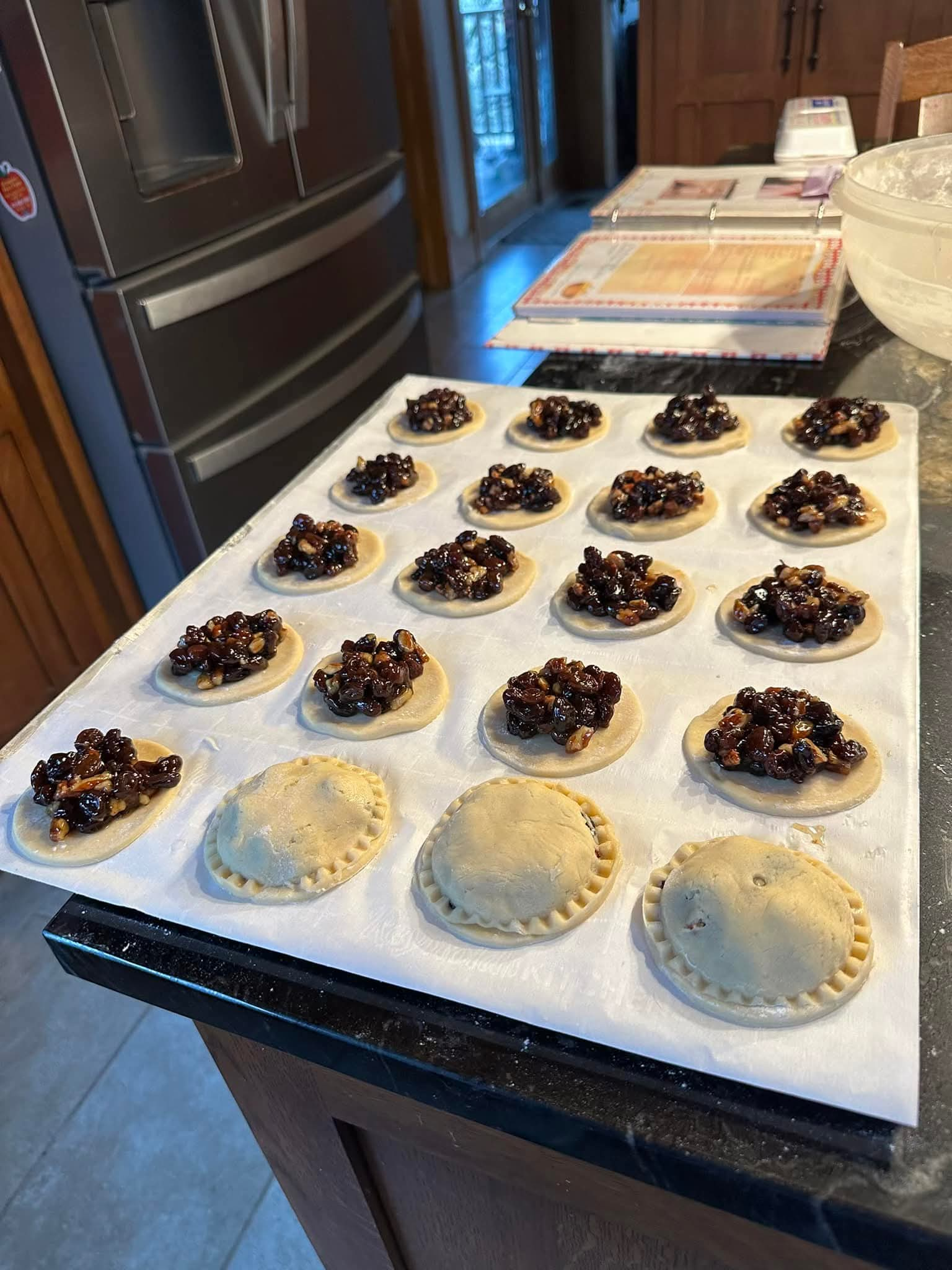
Assembling these cookies is the most time-consuming part of the process, but also the most rewarding. Circles of dough are cut, and a measured amount of filling is placed in the center of each. Using consistent portions ensures even baking and prevents overfilling, which can cause leaks.
A second dough circle is placed on top, and the edges are sealed. Moistening the edges with a small amount of water helps the layers adhere. Crimping with fingers or a simple tool secures the seal and gives the cookies their traditional appearance. Careful sealing is essential, as it keeps the filling inside during baking.
Baking and Cooling
The cookies are baked at a moderate temperature until just lightly browned. They should not be dark or crisp. The goal is a tender cookie with a soft interior. Baking on parchment paper is helpful, as it prevents sticking and makes cleanup easier if any filling escapes.
After baking, the cookies should be allowed to cool completely. This step is important, as the filling continues to set as it cools. Handling them too soon can cause breakage or leaking.
Storing and Freezing
One of the reasons these cookies have remained popular for generations is their ability to store well. Once cooled, they can be kept in an airtight container for several days. For long-term storage, freezing is ideal.
Frozen filled raisin cookies maintain their flavor and texture remarkably well. They can be thawed at room temperature and enjoyed as if freshly baked. Many families portion them out to last throughout the year, making them a comforting reminder of holidays and loved ones.
A Recipe Worth Preserving
Old-Fashioned Filled Raisin Cookies are not flashy or modern, but they are deeply meaningful. They represent a way of baking that values patience, resourcefulness, and care. Each cookie is a small, sealed package of tradition, meant to be shared and remembered.
Preserving recipes like this ensures that future generations can experience the same flavors and rituals. Writing it down, baking it together, and passing it along keeps family history alive in a way few other things can. These cookies are proof that sometimes, the simplest ingredients and the longest methods create the most lasting impressions.
Conclusion
In a world of quick desserts and instant gratification, Old-Fashioned Filled Raisin Cookies stand as a reminder of slower times. They invite us to pause, to work with our hands, and to bake with intention. Whether made for a holiday, a family gathering, or simply to honor tradition, these cookies carry more than just filling inside. They carry stories, love, and generations of care.